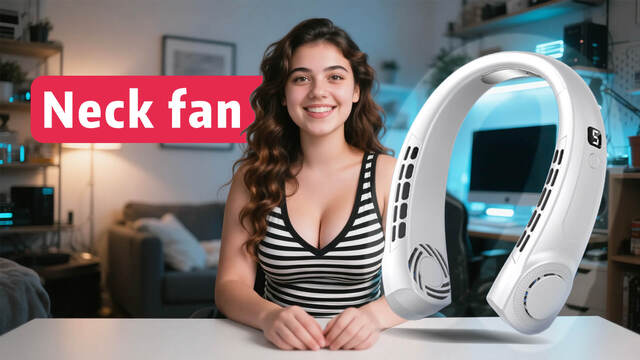
On a scorching summer day, have you ever experienced this: carrying a heavy backpack, clutching a small fan, and breaking into a sweat after just a few steps, your wrist aching so much you can barely hold the fan? Or perhaps on a crowded subway during your commute, the stifling air mixed with the smell of sweat makes you feel suffocated, and all you want to do is escape? In the office, the central air conditioning never seems to reach your workstation, your fingers feel sticky and slippery on the keyboard, and your productivity plummets. When the limitations of traditional fans collide with the summer heat, we urgently need a revolution in cooling experiences – and the neck fan is the central protagonist of this revolution. It's not headphones, yet it acts like a constant companion; it has no blades, yet it delivers 360° all-around cooling. This summer, let the neck fan redefine the standard of "portable cooling."
From "Handheld" to "Neck-Worn": A Milestone in the Evolution of Fans
The history of humanity's fight against the heat is also a history of tool evolution. From ancient people fanning themselves with palm-leaf fans, to the introduction of desktop fans into countless homes in the last century, to handheld fans becoming a summer staple, the form of fans has always revolved around "portability" and "efficiency." However, the drawbacks of handheld fans have always persisted: prolonged holding causes arm fatigue, insufficient battery life leads to frequent power outages, and the airflow is concentrated in one area, failing to cool the entire body. As the lifestyles of urban dwellers become increasingly diverse – commuting, outdoors, office work, exercise – the limitations of traditional fans are magnified.
The birth of the neck fan is a precise response to these pain points. It breaks the conventional notion that "fans must be handheld or placed," adopting a neck-worn design that evenly distributes the weight on both sides of the neck, freeing the hands while achieving "airflow that moves with the person." This design inspiration comes from the wearing logic of headphones, but it achieves a revolutionary innovation in function: it doesn't have the audio output of headphones, but through turbine airflow technology, it delivers cool airflow to the neck, face, chest, and other areas prone to sweating. From "passively waiting for the wind" to "actively carrying the wind with you," the neck fan is not only an upgrade in form but also a revolution in cooling experience.
360° Surround Airflow: Redefining the Underlying Logic of "Full Body Cooling""Why do I still feel hot even after using a fan?" This is a common dilemma for many people. Traditional fans rely on rotating blades to propel air, and the airflow spreads linearly, only covering a limited area and quickly weakening with distance. The core breakthrough of the neck fan lies in its innovative 360° surround airflow system, which technically solves the pain point of "localized cooling."
Turbine Air Duct: Strong Wind Without Blades

Unlike the blade structure of traditional fans, the neck fan uses a bladeless turbine design. The built-in high-speed motor drives the turbine to rotate, drawing in air through the Bernoulli principle, and then compressing and accelerating it through a spiral air duct, finally forming a strong airflow from multiple air outlets. This design not only avoids the safety hazard of blades catching hair but also makes the airflow soft and even, preventing the stinging sensation on the skin caused by traditional fans. Taking mainstream neck fans on the market as an example, the number of air outlets is usually between 8 and 12, distributed around the front, back, left, and right of the neck, ensuring that the airflow can envelop the entire upper body.
Three-Dimensional Air Delivery: Saying Goodbye to "Localized Cooling"
The key to 360° surround airflow lies in the precise design of the air delivery angle. The air outlets of the neck fan are not arranged horizontally, but are ergonomically optimized, tilted upwards by 15° and downwards by 20°, combined with a left-right symmetrical layout, forming a three-dimensional wind field. When you wear it while walking, the sweat on your neck will evaporate quickly, the stuffy feeling on your face will instantly dissipate, and your clothes on your chest will remain dry. This experience is completely different from the limitations of handheld fans, which only cool where the air is blown, truly achieving the comfort of "the whole body being in a natural breeze." Three-Level Adjustment: Adapting to Diverse Scene Needs
To meet the cooling needs of different environments, neck fans are usually equipped with three levels of wind speed adjustment:
Level 1 Gentle Breeze: Suitable for quiet environments such as offices and libraries. The gentle airflow doesn't disturb others and provides continuous airflow to keep the body dry;
Level 2 Strong Breeze: Ideal for commuting or outdoor walks, effectively combating temperatures around 30℃ and quickly dissipating body heat;
Level 3 Powerful Breeze: For use in high-temperature environments above 35℃ or after exercise. The strong airflow can instantly lower the perceived temperature by 5-8℃, reducing the risk of heatstroke.
This flexible adjustment mechanism allows the neck fan to be both a "quiet office companion" and an "outdoor cooling artifact," truly achieving "one device, multiple uses."
Comprehensive Scene Coverage: Your Personal Cooling Solution
The charm of the neck fan lies not only in its technological innovation but also in its deep integration into the lives of modern people. Whether you're a commuter working from nine to five, an outdoor enthusiast, or a mother who needs to take care of children for extended periods, you can find a suitable way to use it.
On the Commute: Saying No to the "Sauna Effect"
The subway during rush hour and the bus during peak hours are summer "disaster zones." In crowded, enclosed spaces, air circulation is poor, and body temperature rises rapidly, leaving you sweating profusely after just one stop. The neck fan gives commuters a "mobile air-conditioned room." It hangs around your neck, leaving your hands free, so you can use your phone or hold onto the handrail without any problems; the bladeless design avoids the embarrassment of hair getting caught, and the powerful airflow continuously dispels the stuffiness. One user tested it on a bus at 32℃, using the second level of wind speed, and stayed dry for the entire 40-minute journey, with no sweat stains on their collar upon getting off.

In the Office: A New Desktop Cooling Option
Many offices have the problem of "uneven cooling" from central air conditioning: colleagues near the vents are freezing and need to wear jackets, while those far from the vents feel like they're in a "small furnace." Desktop fans not only take up space but also easily blow papers around. The neck fan perfectly solves this problem: weighing only 200-300g, it's almost imperceptible when worn around the neck; three-speed wind adjustment allows for precise temperature control according to individual needs without affecting colleagues; and the silent design (operating noise below 30 decibels) ensures it doesn't disrupt the office rhythm. Many office workers report that since using a neck fan, the frequency of afternoon drowsiness has significantly decreased, and keyboard operation is no longer hampered by sweaty palms.
Outdoor Scenarios: Balancing Exercise and Cooling
When running, hiking, or camping in the summer, the biggest problem is "the more you move, the hotter you get." Handheld fans not only add to the burden but can also malfunction due to sweat seeping into the circuitry. Neck fans are optimized for outdoor scenarios: IPX4 waterproof and sweatproof design ensures safe operation even when sweating profusely; lightweight materials (ABS+PC) are sturdy and durable, easily handling bumpy terrain; some models are also equipped with a Type-C fast charging interface, charging in 1 hour for 8-12 hours of use, meeting all-day outdoor needs. One camping enthusiast shared that while hiking in a 35℃ valley, the neck fan's three-speed wind continuously cooled their neck, effectively preventing heatstroke, while their companions using handheld fans had to stop midway due to insufficient battery power.